Sophia: One API, One Network, One Suite
One auth layer. One billing relationship. One tenancy model. One dispatchable tool-call surface across voice, twenty-four native business modules, and 34.7M Live enterprise features, connectors and APIs — all bound together by a sovereign private layer-three fabric. Membership in Sophia is the onboarding.
The Thesis
What is being built is one API that does it all. Behind a single consistent call surface lives the entire operational substrate of a modern business: voice (real-time PSTN telephony, predictive dialling, recording, transcription, synthesis), the full library of native business modules (CRM, support ticketing, booking, invoicing, courses, workflow automation, content production, field sales, workforce wellness, finance, infrastructure observability, data warehousing, security and compliance — twenty-four such modules and growing), and a connector library that absorbs every meaningful third-party SaaS and API on Earth.
The intent is not to be a portal that integrates with these things. The intent is to be these things, expressed through one auth-billing-observability layer, one set of dispatchable tool calls, one tenancy model. The network that carries this API — that binds every host, every customer site, every GPU pool, every appliance into a single coherent fabric — is called Sophia.
The cardinal rule, stated plainly: any computer, any server, any appliance that joins Sophia becomes a SARAH AI Suite client immediately. There is no installer ritual, no per-vendor onboarding sequence, no separate SDKs for voice versus CRM versus payments versus connectors. Membership in Sophia is the onboarding.
Chris Ismail · Founder, IDESKS ONLINE AI
What’s Inside the API
The API surface is layered, but presented as one.
health · list · get · create · update · action · log. When a customer pushes a record to a CRM, pulls a ticket from a help desk, or settles a transaction through a UK Open Banking endpoint, the call shape is identical to any other tool call. The vendor underneath becomes an implementation detail.The Connector Library · Live Today
Sophia’s connector layer is the largest unified enterprise-API surface ever assembled under a single tenancy model. As of 2026-05-18 the live fabric contains 1.5M connectors (405,807 unique functional roots), organised into 191,773 categories, reaching 34.7M (34.7M) addressable endpoints, features and APIs — composed from the following structural cohorts.
accounting, airline, bank, billing, calendar, crm, ecommerce, email, esign, gaming, government, healthcare, hotels, payments, storage, support, workflow, and 46 more.airline category root.bank category root..example.com.au. APRA / ASIC / AUSTRAC compliance flags set per category..example.gov.Canonical Verb Set
Every one of the 34.7M entries on the fabric speaks the same seven-verb canonical language. There are no per-vendor SDKs, no per-category exceptions, no “legacy API” carve-outs that customers need to special-case in their integration code.
| Verb | Semantics | Use |
|---|---|---|
health | Liveness + auth probe | Confirms the underlying vendor endpoint is reachable and our credentials are valid. |
list | Enumerate available records | Returns paginated records under the connector instance (accounts, contacts, tickets, deals, etc.). |
get | Retrieve a single record | Returns the canonical representation of one record by ID. |
create | Write a new record | Posts a new record to the underlying vendor and returns the canonical representation. |
update | Mutate an existing record | Partial-update an existing record; supports optimistic concurrency where the vendor exposes it. |
action | Invoke a domain-specific operation | Vendor-specific verbs (charge, refund, send, settle, dispatch) projected into a uniform invocation shape. |
log | Append to the canonical activity spine | Writes the invocation, response, and side-effects into the per-contact activity record — the regulator-grade audit trail. |
Sophia as a Network
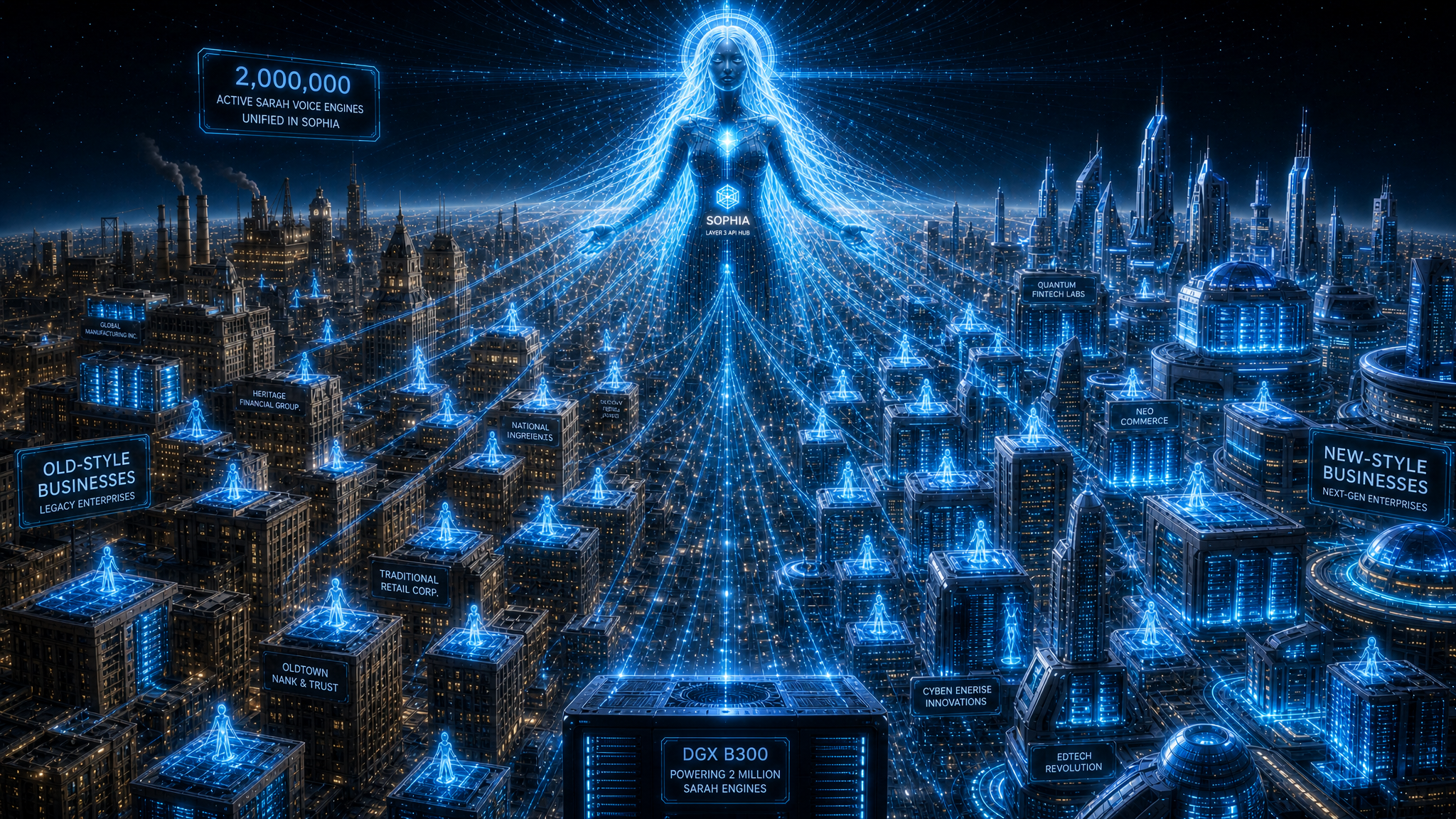
Sophia is a private layer-three fabric. Its transport today is a WireGuard mesh joining hosts in three continents — a European hub, an Australian edge, a North American edge, plus a permanent on-premise mirror — and it is being grown into a sovereign edge network anchored by NVIDIA Grace Blackwell Sparks acting simultaneously as GPU inference nodes and carrier-grade routers.
Joining Sophia
A new participant becomes a Sophia member through a thin client agent and an auth handshake. The agent installs once. It generates a WireGuard keypair, registers with the Sophia identity service, negotiates peer routes, mounts the unified API endpoint at a stable local address, and from that moment forward the host behaves like a SARAH AI Suite tenant. Voice calls route inward. Connector calls route outward. Workflows run. Per-contact activity flows into the spine.
The customer’s CFO sees one line item — SARAH AI Suite, monthly subscription — not a calendar tool plus a CRM plus a bookkeeping suite plus a telephony provider plus a help desk plus thirty more.
For computers that already exist — a customer’s old Postgres-backed CRM, a billing server, a call-centre floor of softphones, a partner’s audit system — Sophia membership is also the integration path. A read-only connector slug exposes their data inward. A write-side tool call pushes events outward. There is no separate “API gateway” project to stand up. There is the one API; there is Sophia.
Why This Matters
Every SaaS empire today is fragmentation: thirty surfaces, thirty auth schemes, thirty billing relationships, thirty observability stacks, thirty places a request can fail silently. Sophia is the inverse bet — that the customer does not want thirty APIs, they want one outcome, and the outcome surface is a single consistent place where intent goes in and action comes out.
The endgame is a planet-scale federation of Sophia members — millions of edge appliances at homes, businesses, hospitals, airlines, call centres, sovereign clouds — each running the same client, each able to compose with every other through the same one API. Per-owner SARAH appliances negotiate calendar, contract, real-estate, vendor and settlement decisions across Sophia using a signed agent-to-agent protocol. Emergency compute floods across the fabric to where disasters strike. A watershed of sensors and a fleet of robots and a hospital’s tumour-board second opinions all transact on the same call surface.
The picture, then, is not a product. It is a fabric. SARAH speaks at one end; the world answers at the other; Sophia is what makes that conversation a single sentence.
Chris Ismail · Founder, IDESKS ONLINE AI

The Hardware Substrate
Sophia operates on a three-tier compute substrate, all reachable across the same private layer-three fabric, all expressed through the same one API.
| Tier | Hardware | Role on the fabric | Models in residence |
|---|---|---|---|
| Edge | NVIDIA Grace Blackwell Spark GB10 | Concurrent GPU inference, WireGuard concentration, BGP peering, STT, TTS, voice runtime, local portal. One box, one data-centre footprint. | 8 B · 26 B (MoE A4B) · 31 B · 32 B |
| Dense | NVIDIA GB300 Workstation racks | Full-precision 72 B language model service for cohort-wide reasoning, document understanding, code generation, structured extraction. Acts as Sophia’s mid-tier brain. | 72 B (full precision) |
| Apex | NVIDIA HGX B300 8× B300 | 235 B conversational manager service and trillion-parameter Deep Thinker rotation. 2,304 GB unified HBM3e at 64 TB/s aggregate. The SOPHIA Kimi K2.6 + GLM-5.2 dual-brain resides here. | 235 B · 1 T-class rotation |
HRM-Symbolic (27 M) and HRM-Text (1.15 B) from Sapient Inc are pinned to every Spark node as a structured-reasoning co-processor that the Transformer fleet can invoke for constraint-satisfaction, scheduling, and symbolic problems where chain-of-thought underperforms.
Available Today
Sophia is the operational substrate of SARAH AI Suite, commercially available worldwide as of 2026-05-18. Two appliance tiers operate on the live fabric:
- SARAH Enterprise — Dual NVIDIA DGX B300 Servers appliance · 1,000 concurrent voice agents · for tier-1 / tier-2 banks, federal and state agencies, health systems, airlines, hotel chains, and BPOs. Industry pages at scale-growth.ai/edms/.
- SARAH Spark 2 — Compact desktop-class appliance · 2 concurrent voice calls · for solo practitioners and single-location operators in healthcare, dental, veterinary, multi-specialty clinic, and restaurant verticals. Industry pages at scale-growth.ai/spark2-edms/.
Both tiers operate the same SOPHIA Layer-3 API HUB, the same 34.7M-entry connector fabric, the same WireGuard mesh, the same canonical verb set, and the same 36-month Global Replacement Warranty. The appliance is depreciable on the customer balance sheet, located within the customer’s controlled environment, with customer-held encryption keys and a complete audit trail covering every call, prompt, and output. No third-party model API calls. No per-token billing leakage. No multi-tenant data-residency exposure.